Make beats. In your browser.
A groovebox built for the web. Eight tracks. Sixteen steps. Unlimited patterns. No installation.
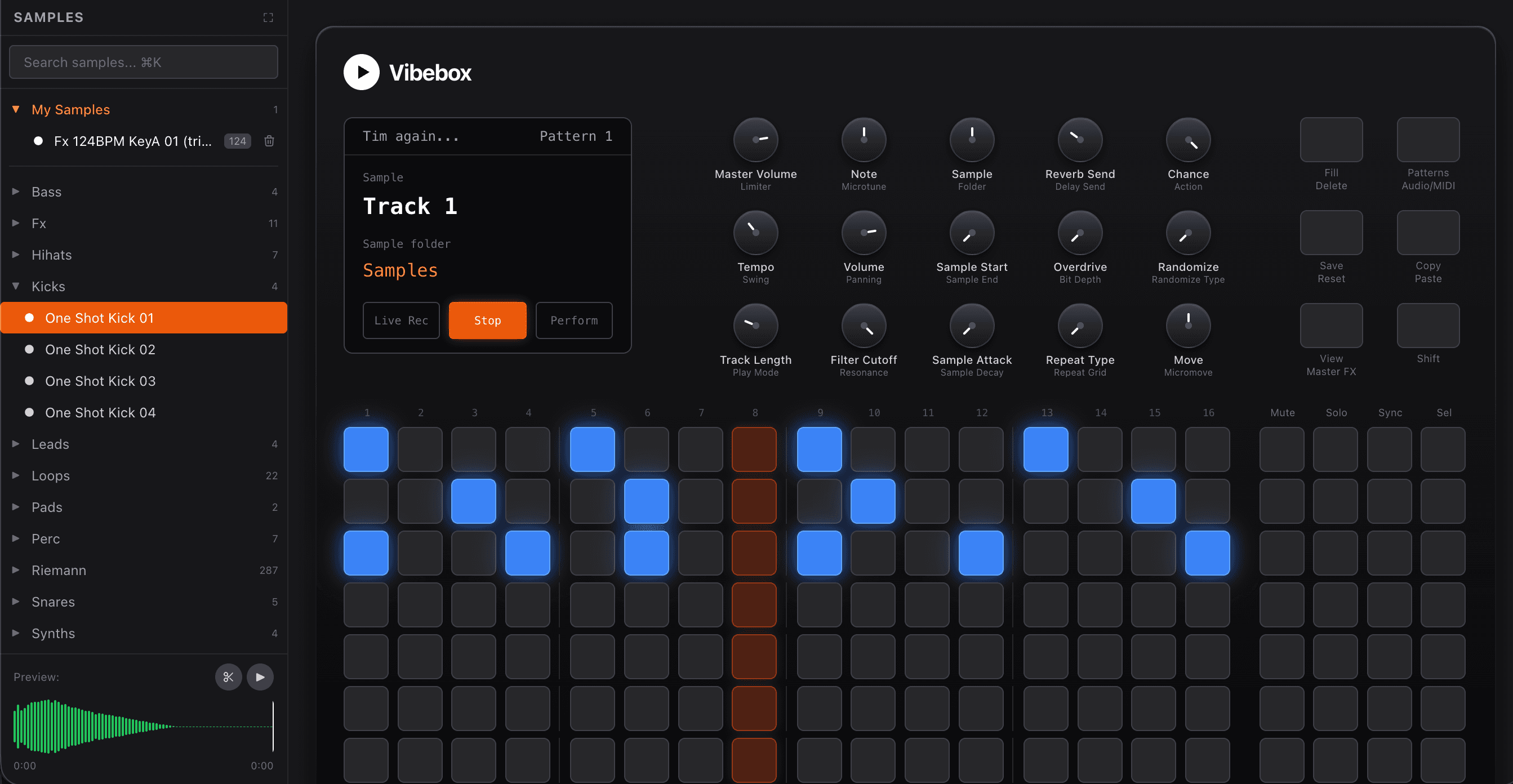
A groovebox for the browser
Inspired by hardware like the Polyend Play and Elektron Digitakt. No plugins. No DAW. Just open and create.
8-Track Step Sequencer
16 steps per pattern
Each track holds a sample. Each step triggers with its own settings: volume, pitch, pan, filter, effects. Click pads to program beats. Hear them instantly.
Sample Browser
Waveforms & trim editor
Browse with waveform previews. Found silence at the start? Open the trim editor, drag handles, save to your library. Your edits stay with your account.
Pattern Chains
Build full arrangements
Chain patterns into arrangements. Loops sync to tempo automatically. Build verses, drops, and breakdowns — all in your browser.
Native Web Audio
Low latency, no plugins
Everything runs in Web Audio API. Latency stays tight. Works on any device with a modern browser. Just open the URL and start making music.
Everything you need.
Nothing you don't.
Step Sequencer
Eight tracks. Sixteen steps per pattern. Per-step control over volume, pitch, pan, and effects.
Sample Library
Browse, preview, and trim samples. Waveform visualization. Save your own edits to a personal library.
Pattern Arrangement
Build patterns. Arrange them into songs. Automatic tempo sync for loops and samples.
The details.
Master Electronic
Music Production
Techno
Techno originated in Detroit, Michigan between 1985 and 1988. Three high school friends from Belleville—Juan Atkins, Derrick May, and Kevin Saunderson—developed the genre by combining the electronic sounds of Kraftwerk with funk rhythms from Parliament-Funkadelic and the emerging Chicago house scene. The genre is characterized by repetitive 4/4 beats typically ranging from 120 to 150 BPM, synthesizer-driven melodies, and a futuristic aesthetic rooted in Detroit's post-industrial identity.
House
House music emerged in Chicago between 1983 and 1985, named after The Warehouse nightclub where DJ Frankie Knuckles pioneered the sound. When disco declined after 1979, Chicago DJs began extending disco breaks with drum machines—particularly the Roland TR-909—and layering European electronic music. The genre established the 4/4 kick drum pattern, offbeat hi-hats, and soulful vocal samples that remain foundational to electronic dance music.
Electro
Electro emerged in the early 1980s when producers in New York, Detroit, and Los Angeles fused Kraftwerk's electronic aesthetic with American funk using the Roland TR-808 drum machine. Afrika Bambaataa's "Planet Rock" (1982) defined the genre: machine-generated rhythms, synthesized basslines, and a futuristic vision that directly influenced hip-hop, techno, Miami bass, and modern trap.
Deep-dive articles with interactive examples
Learn music theory, sound design, and production techniques with playable patterns and audio examples.
Ready to create?
Sign in with your email or Google account to get started.